


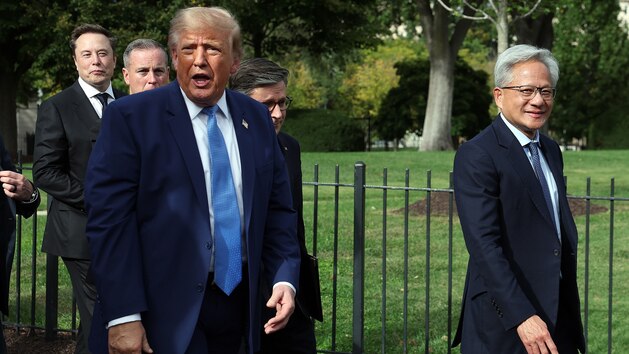
President Donald Trump is traveling to Asia for meetings with global leaders and for his second visit to China for a meeting with Chinese President Xi Jinping. The president’s trip comes as questions linger about what the administration knew about prominent tech CEO Jensen Huang’s affair with a woman alleged to be a Chinese spy.
Trump will participate in the first-ever trilateral meeting between the leaders of the U.S., China and Russia on the sidelines of the APEC Summit in China, senior U.S. officials said. The president is expected to discuss the war in Iran with Xi and Russian President Vladimir Putin. However, he does not intend to discuss Ukraine during the trilateral meeting, officials say.
Denuclearization will be the focus of the long-awaited trilateral meeting, though officials said they do not anticipate the leaders reaching any concrete agreement and are characterizing this meeting as an initial conversation broaching the subject.
Trump had been teasing a potential face-to-face meeting with the world’s leading nuclear superpowers for some time. On Oct. 19, Trump told ABC News Chief White House correspondent Mary Bruce that he would like to meet with Putin and Xi when he visits China, saying “I would do that,” and indicated a desire to discuss denuclearization.
Trump and Xi will have a bilateral meeting ahead of the trilateral, though Trump and Putin will not be meeting one-on-one separately, the officials said.
Billionaire Elon Musk will be joining Trump for parts of his China travels. Officials did not specify his reason for accompanying the president, merely pointing to Musk’s business interests in China.
An official said they expect some additional U.S. business leaders to be attending the APEC CEO Summit, but clarified that they are not part of the U.S. delegation.
Breakdown of the trip
Trump is expected to leave Washington in the morning of Monday, Nov. 16 and arrive in Manila in the evening of Tuesday, Nov. 17, and will head to a bilateral meeting with the other members of the Quad, a diplomatic partnership the U.S. has with Australia, India, and Japan, about peace and security in the Indo-Pacific region. The president is also expected to sign a trade deal with Thailand.
He will then participate in an ASEAN cocktail reception followed by a summit dinner.
The next day, Trump will participate in a welcome ceremony at Malacañang Presidential Palace, the official residence of Filipino President Ferdinand “Bongbong” Romualdez Marcos Jr., followed by a bilateral meeting. He will also participate in an Association of Southeast Asian Nations cocktail reception followed by a summit dinner.
After Wednesday’s events in the Philippines, Trump travels to Shenzhen, China, where it is expected that a minister will greet Trump on the tarmac. He will participate in an APEC leaders’ dinner and multilateral meeting with the APEC leaders. On Thursday afternoon local time, Trump will participate in a bilateral meeting and working lunch with Chinese President Xi.
The historic trilateral Trump-Xi-Putin trilateral meeting will be the final event on the president’s Asia swing.
Jensen Huang’s affair with alleged Chinese spy
Each of Trump and Xi’s meetings this year have been clouded by other topics.
When Trump visited China in May, the raging war in Iran overshadowed the state visit that was scheduled after a detente in Trump’s tit-for-tat trade war. Also, when Trump welcomed Xi in September, the pomp and circumstance Trump had planned went without live TV coverage after his banning outlets from the press pool led to a network boycott.
Now, in the background of this trip, is the scandal involving Nvidia’s CEO, Huang, who joined Trump’s last trip to China earlier this year after boarding Air Force One during a refueling stop in Alaska, according to pool reports at the time. Huang was reported to have had an affair with Alice Huang, a Chinese national and tech executive who is accused of being a Chinese spy.
Officials said they do not expect Trump to raise the allegations against Alice Huang, the suspected Chinese spy, with President Xi, adding that the two presidents plan to focus on implementing aspects of their trade agreement.
“You know, I think when it comes to some of these national security matters and examinations and investigations that are going on in the U.S., it’s probably not something that we’re going to read the Chinese in on at this moment,” a senior U.S. official said.
Huang resigned from Nvidia’s board and as its president and CEO on Nov. 12.
This scandal engulfing Huang has introduced scrutiny over Trump’s ties to him and what Trump and other administration officials knew about the relationship with the alleged spy.
“Well, I’ve been hearing about it and I’ve been reading a little bit about it over a period of time. But, not too long ago,” Trump told reporters during an impromptu press conference in the White House briefing room on Nov. 9.
When pressed on if he was aware of the allegations during his May trip to China, Trump said: “No, I didn’t hear about it then. But a lot of people have heard about it, and Jensen totally denies that he had.”
On May 12, Secretary of State Marco Rubio shared intelligence with Trump on Air Force One showing Huang was in a relationship with a woman believed to be a Chinese spy, a U.S. official and two sources familiar with the matter told ABC News. This is the second known time that Trump had been warned about the plot. Trump was briefed by Rubio shortly before Huang was set to join Trump on the trip to China, the U.S. official and sources said.
A U.S. official and a source familiar with the matter told ABC News that after Air Force One landed in China, White House officials asked for business leaders — including Huang — to be allowed into a meeting with President Xi. Initially, the Chinese were hesitant to adjust the program, but ultimately agreed to it.
Huang, who co-founded Nvidia, one of the world’s most-valuable companies and the maker of chips that top AI companies heavily rely on, has been a constant presence around Trump, who has invited tech executives to multiple events, both at the White House and on overseas trips. Since April 28, when Huang and his wife, Lori, attended a state dinner for King Charles III and Queen Camila, the tech CEO has participated in at least six events with Trump, including the September state dinner for Xi.
Huang has lobbied for policy positions that benefit China and Chinese companies over the past few months.
For example, the U.S. has long blocked China’s access to American AI chips. However, in December 2025, after lobbying from Huang, Trump loosened those restrictions — approving the sale of some older but still powerful chips to China as part of a remarkable deal that gave the U.S. government a 25% cut of the sales.
And in July of this year, Huang joined the social media platform X to push back against possible bans on open-weight AI models, the type that Chinese companies have embraced, and which would be cheaper for businesses and governments to adopt. The ban would benefit American companies OpenAI and Anthropic, which use closed models. The U.S. was reportedly considering those bans.
“The world needs both frontier closed models and frontier open models,” Huang wrote in his first-ever X post.
Midterms
This trip marks Trump’s first one overseas since American voters handed him and Republicans a devastating defeat in the midterm elections. Voter Polls show voters rejected the president’s tariffs and the war in Iran — two of Trump’s key foreign policy positions.
The tariffs have been ensnared in legal challenges in count — and Democrats, who will take the majority in January, have vowed to counter them and reassert congressional authority over trade. They don’t have a veto-proof majority, however, and Trump has vowed to use his veto pen to kill bills he doesn’t like.
And the president does not appear to feel pressure to reign in his sweeping tariffs. On Nov. 12, he threatened to double tariffs on Mexico if they don’t stop what he claims are caravans heading to the southern border post-midterms.
Copyright © 2026, ABC Audio. All rights reserved.