


CLEVELAND, Miss. — Two Delta State University students gained advanced research experience this summer through programs designed to prepare undergraduates for graduate study and careers in science and medicine.
Kent Humphries, a biology major from Fulton, conducted research at Delta State under the mentorship of Sullivan-Outlaw Professor of Biochemistry Christopher Jurgenson through a Summer Undergraduate Research Fellowship.
Humphries’ research examined enzymes involved in the biosynthetic pathway plants use to produce berberine, a naturally occurring compound with potential pharmaceutical applications.
During the fellowship, Humphries learned computational methods for studying protein movement through molecular dynamics simulations. He also gained laboratory experience transforming bacterial cells with recombinant DNA to create protein-overexpression strains and using protein purification techniques to isolate enzymes for further study.
Thomas Craft, a biology major from Cleveland, participated in the Summer Research Experience for Emerging Research Institutions, or RER, in the Department of Biomedical Engineering at the University of Mississippi.
Craft was the first student to participate in the new research format, which is designed to expand access to research opportunities at major universities for students from regional institutions such as Delta State.
Craft spent about a month conducting research on the University of Mississippi campus before returning to Delta State to continue the collaboration. Unlike a traditional nine-week residential summer research program, the RER model allows students to establish research partnerships at Ole Miss and remain involved in their projects over a longer period while continuing their studies and research at their home institutions.
His project focused on glycosylation through novel protein design. Craft used RFdiffusion3, an artificial intelligence-based protein-design platform, to design proteins capable of binding to C-mannosylation sites.
The project gave Craft experience applying emerging computational methods to research involving protein engineering, biochemistry and biomedical science.
At the conclusion of the on-campus portion of the RER program, Craft presented his work alongside other summer research participants at Ole Miss. He discussed the progress of his protein-design research with faculty members, mentors and fellow students.
The pilot program also included a faculty collaboration component designed to strengthen long-term research connections between Delta State and the University of Mississippi.
Jurgenson traveled to Ole Miss, where he collaborated with Sushil Mishra and met with other faculty members to discuss shared research interests and opportunities for continued collaboration.
The faculty component is intended to support sustained partnerships beyond a short-term summer research placement.
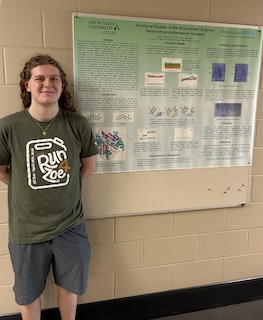
Humphries, Craft and Jurgenson also attended the Mississippi IDeA/EPSCoR Conference, where they met students and researchers from institutions across the state. Humphries presented a poster detailing his research on enzymes involved in the berberine biosynthetic pathway.
“Throughout this summer, I have learned so much,” Humphries said. “Getting to work closely with my mentor in the laboratory has been a wonderful experience. Presenting at the MIEC conference gave me an opportunity to talk about my findings and meet peers who have similar interests.”
Craft said the RER program provided an opportunity to gain experience in a different research environment.
“I enjoyed my time as part of the RER at Ole Miss,” Craft said. “It was a great opportunity to meet other students interested in research, receive mentorship in a different laboratory setting, and bring what I learned back with me to Delta State.”
Jurgenson said the programs demonstrate the importance of creating multiple pathways for students at regional universities to participate in research.
“These programs give our students opportunities to work closely with faculty, develop practical research skills, and become part of a broader scientific community,” Jurgenson said.
He said the collaborative RER model is particularly promising because it allows students to continue their research after returning to Delta State while faculty members build partnerships that could create additional opportunities for students.
The students’ participation highlights the value of partnerships among Mississippi universities. By connecting Delta State students with research opportunities on campus and at the University of Mississippi, the programs expand access to undergraduate research and strengthen scientific collaboration across the state.
The SURF grant was supported by the Mississippi IDeA Network of Biomedical Research Excellence, funded by the National Institute of General Medical Sciences of the National Institutes of Health under grant No. P20GM103476.
For more information about undergraduate research opportunities, visit Delta State University’s College of Nursing and Health Sciences website.