


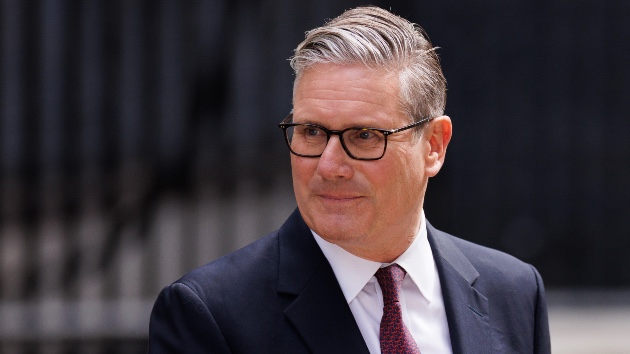
(LONDON) — Prime Minister Keir Starmer announced on Monday he would resign as the leader of his party and as prime minister, setting the stage for the United Kingdom’s seventh prime minister within a decade.
Starmer, who said he spoke on Monday with King Charles, said he expected to remain in office until a successor was chosen from within his Labour Party.
“The question my party is asking now is whether I am best placed to lead us into the next general election,” he said outside 10 Downing Street. “I have heard the answer of my parliamentary party to that question, and I accept that answer with good grace.”
Starmer, who had led Labour since 2020, was elected to lead the country in a general election 2024. His replacement is expected to be chosen by his party.
Starmer said he asked party leaders to open nominations for a successor on July 9. He did not give a date for his departure from 10 Downing Street, but said he expected a new prime minister to be in place by September, when Parliament returns from its summer recess.
The resignation announcement followed months of turmoil for Starmer, with some members of his own party criticizing his leadership, saying he had not been able to deliver the rapid change needed after taking office following 14 years of Conservative Party rule in Britain.
Many in Starmer’s Labour party had written to Starmer asking him to step down following local elections in May, which saw the party lose more than 1,000 seats on local councils, results that were widely interpreted as a repudiation by British voters of Labour’s performance under the prime minister’s leadership.
A formal challenge to his premiership had not yet begun as of Monday, but some members of his party have in recent weeks coalesced in public support of Andy Burnham, the former mayor of Greater Manchester, as his potential successor.
Burnham, who won a special election on Friday to become a member of parliament representing Makerfield, was expected to be sworn in in the House of Commons on Monday.
Following Starmer’s announcement, Burnham said on social media that he would seek a nomination in the Labour leadership contest.
“People want to see progress on economic growth, cost of living, public services, housing and opportunities for the next generation,” he said. “Political change should never distract from the responsibility to improve people’s lives.”
Another potential successor, Wes Streeting, a member of parliament who resigned from his position as Starmer’s health secretary in May, threw his support behind Burnham on Monday.
“We could spend the summer exaggerating our small differences, or we can roll up our sleeves and help [Burnham] to deliver the change our Party and our country needs,” Streeting said in a statement. “That is the choise that I am making and I hope that everyone else will back Andy, too.”
Starmer long said he intended to see out his full five-year term, which began with his party’s 2024 landslide election victory, which also delivered Labour a historic majority in the House of Commons.
Ursula von der Leyen, the president of the EU Commission, praised Starmer after his announcement, saying, “It can take many leaders years to grow into the statesman you became in just two years. European and Ukrainian security is stronger because of you. Thank you, dear Keir.”
ABC News’ David Brennan, Jamie Dorrington and Zoe Magee contributed to this report.
Copyright © 2026, ABC Audio. All rights reserved.